


If you are a single woman over 50 looking for a travel group that gives you company without a partner, here is the short answer: the groups worth your money keep the group small (6 to 10 travelers), give you your own room, and charge no single supplement to do it. Everything else is negotiable. Those two things are not. Women Travel Abroad runs groups of 6 to 10 women, gives every traveler a single-occupancy boutique room at no extra charge, and starts the group talking to each other four separate times in the ninety days before departure. That means you already know the women you are traveling with before you land.
“Single” here covers a lot of ground. Never married. Divorced. Widowed. Married to someone who would rather stay home. What these situations share is a practical problem: you want to see Portugal or Jordan or the fjords of New Zealand, you do not want to do it entirely alone, and you do not have a built-in travel partner. A good single travel group solves exactly that. A bad one charges you extra for the privilege and seats you at dinner with fourteen strangers.
This guide walks through what a “single travel group” actually is, why group size and rooming matter more than the brochure photos, the real math behind the single supplement, and how to vet a group before you hand over a deposit.
What “Single Travel Group” Actually Means
The phrase gets used loosely, so it helps to be precise. A single travel group is a small-group tour built for people traveling without a companion, where the whole model assumes you arrived on your own and expects you to leave with new friends. That is different from a standard group tour that happens to accept solo bookings and then quietly penalizes them.
Two versions exist, and the difference matters.
The first is the tour that welcomes solo travelers but is structurally built for pairs. Pricing is quoted per person based on double occupancy. Book alone and you either pay a supplement to keep the room to yourself or get assigned a roommate you have never met. The group might be forty people, most of them couples. You are technically welcome. You are not the point.
The second is the tour designed from the ground up for women traveling solo. Single-occupancy rooms are the default, not an upsell. Group sizes are small enough that no one gets lost. The pre-trip logistics assume you know no one and build in ways for the group to connect before departure. This is the model that works for single women over 50, and it is the model Women Travel Abroad was built around. Over 95% of travelers book as solo individuals, so the whole experience is calibrated for women arriving on their own rather than tacked onto a couples-oriented itinerary.
When a company says it caters to solo travelers, ask which version it is. The answer is usually sitting in the single supplement policy.
The Single Supplement Math (And Why It Falls Hardest on Women Over 50)
Here is the fee that quietly reshapes solo travel budgets. A single supplement is a surcharge added when one person occupies a room priced for two. Hotels, cruise lines, and tour operators use it to recover the “lost” revenue of an empty second bed. It is calculated as a percentage of the base per-person price, typically between 25% and 100%, and is charged to offset the unoccupied second bed.
Run the numbers on a real trip. Say a ten-day tour is advertised at $4,000 per person, double occupancy. A 50% single supplement adds $2,000. A full 100% supplement doubles your bill to $8,000 for the identical itinerary in the identical room. You are paying a second person’s fare to travel by yourself.
This lands hardest on women, and the data is not subtle. Yet the industry’s pricing was built around paired travel. In JourneyWoman’s “Invisible No More” study, 78% of women over 50 said the single supplement is the biggest barrier to solo travel. More than three-quarters of the exact travelers these tours claim to serve are being priced out by a single line item.
For women over 50 specifically, the reasons for traveling solo are often not a lifestyle choice. Divorce, widowhood, a partner with health limitations, adult children who have moved out: these are the life transitions that bring many women to travel on their own for the first time. Charging a premium on top of that adjustment is tone-deaf at best.
Do women-only travel companies charge single supplements? Some do, some do not, and the difference tells you everything about who the company was designed for. The best ones have eliminated the practice structurally. Women Travel Abroad charges no single supplement and states this on every trip page. The price you see is the single-occupancy price. There is no second number waiting for you at checkout.
That structural choice has a measurable effect on whether women keep traveling. Over 60% of women who travel with Women Travel Abroad book a second trip within 12 months, in large part because removing the supplement makes annual international travel financially realistic. When the solo tax disappears, a trip abroad becomes a habit rather than a rare splurge.
Your Own Room Is Not a Luxury. It Is the Point.
Some companies dodge the single supplement a different way: they waive the fee but pair you with a stranger to share a room. For a woman over 50, this is usually a worse deal than the fee itself.
Think about what shared rooming actually means over ten days. You are negotiating the thermostat with someone you met at the airport. You are coordinating shower schedules. You are matching sleep patterns, snoring included, with no door to close between you and the group. After a full day of walking through Marrakesh or hiking a coastal trail, the one thing that lets you show up rested the next morning is a private space to retreat to. Shared rooming removes it.
This is why single-occupancy rooms are non-negotiable in a good single travel group. Not shared-with-a-stranger. Not available-for-a-fee. Yours, by default. Women Travel Abroad guarantees single-occupancy boutique rooms for every traveler on every trip. The company’s own position on this is blunt: you build community during the day and go back to your own room each night to actually rest, without worrying about shower schedules or what temperature to set the thermostat to please both people.
When you compare groups, separate two questions that often get blurred together. Does the company charge a single supplement? And does it guarantee a private room? The gold standard is no supplement and a guaranteed private room. A company that only clears one bar is solving half the problem.
Read more about which travel companies actually deliver and which do not.
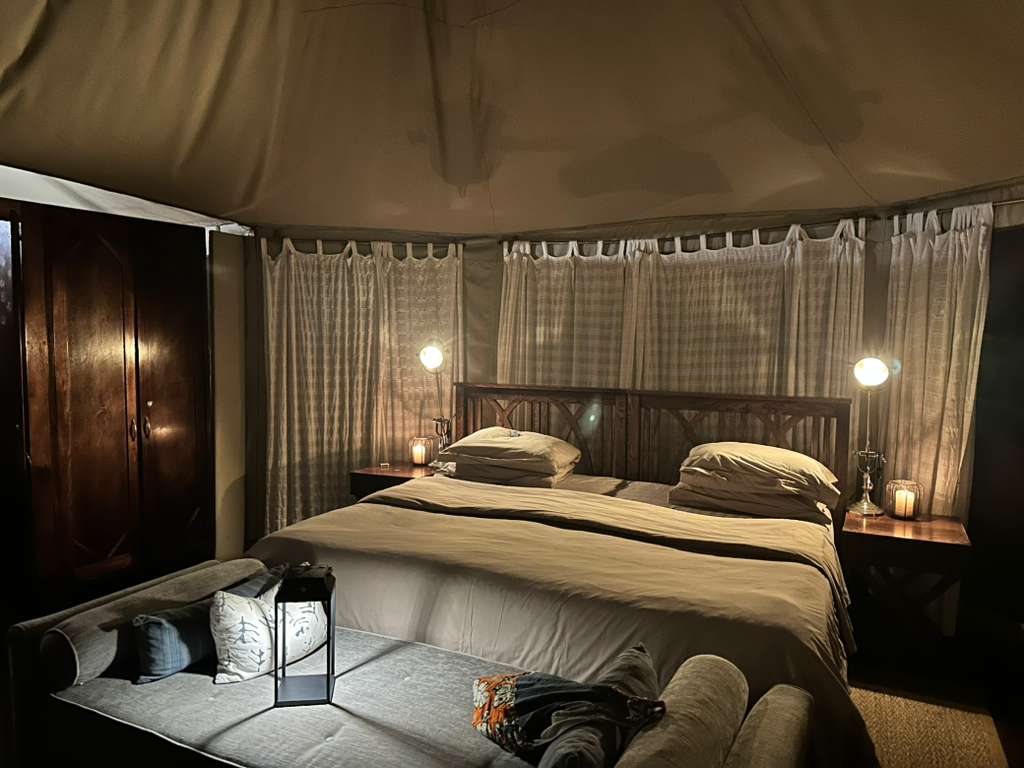
Luxurious room on WTA’s South African safari
Why Groups of 6 to 10 Change the Whole Experience
Group size is the variable most travelers underweight, and it quietly determines almost everything else about the trip.
A group of 40 is a logistics operation. You move on the company’s clock. Boarding the bus, ordering at a restaurant, waiting for the last person back from the restroom: all of it scales with headcount. You will not learn everyone’s name. You will spend real time waiting. And as a single traveler, you can disappear into a crowd that size, which is the opposite of what you signed up for.
A group of 6 to 10 is a dinner table. Everyone knows everyone by the second day. The pace flexes to the group instead of the group bending to a schedule. A local guide can actually answer your specific question rather than shouting logistics over a microphone. Most importantly for a single woman, there is nowhere to get lost. You are part of the group by default, not by effort.
What are the benefits of small group travel for solo travelers? Small groups make genuine connection the default rather than something you have to work for, give you real access to the guide and the destination, and eliminate the get-lost-in-the-crowd problem that makes large tours isolating for people traveling alone. Women Travel Abroad caps every trip at 10 women for exactly these reasons, having found across more than a decade of trips that this range creates the right balance between a real community and enough breathing room that you are not locked into the same three people for two weeks.
There is a floor as well as a ceiling. A group of two or three can feel thin, and if you do not click with the other travelers, there is nowhere to go. Six to ten is wide enough that you will find your people and narrow enough that you will actually meet all of them.
Match the Pace Before You Match the Destination
Group size and rooming are easy to check. Pace is the one that catches first-timers, because almost every operator describes it in adjectives.
“Moderate.” “Active.” “Leisurely.” None of those words tell you anything. Moderate to a company selling Kilimanjaro treks means something different than moderate to a company selling wine regions. Ask for numbers instead, and judge the operator by whether it has them.
A serious activity rating answers four questions. How far do you walk in a day, in miles. What is the ground like, including stairs and inclines. How long are you on your feet without a break. And what level of fitness does the trip assume. Women Travel Abroad publishes all four on every trip page. The South Africa itinerary is rated for walking tours of 2 to 3 miles at a steady pace, moderate inclines with multiple flights of stairs, and activities that can run up to 2 hours of walking or standing with fewer breaks. You can read that before you pay a deposit and decide honestly whether it is your trip.
Here is the question most women ask wrong. Not “can I walk three miles,” because almost everyone reading this can walk three miles. Ask whether you can walk three miles on day one, then again on day four, then again on day eight, on a schedule you did not set. Stamina across a full itinerary is the real test, and it is why rest days matter more than any single day’s mileage.
So check for the gaps. Look at how many days have nothing scheduled, and whether free time is a real afternoon or forty minutes before dinner. Women Travel Abroad travelers mention free days more than almost anything else in their reviews, which tells you the trips are built with room in them. One traveler who took the St. Lucia wellness retreat in October 2025 wrote on TripAdvisor that the pace was manageable, not frenetic. Check out more insights from past travelers on our Tripadvisor page.
If a trip page will not give you distances, call and ask three things: what time does the earliest morning start, what is the longest walking day, and is there a day with nothing on it. An operator that knows its own itineraries answers immediately.
One more thing worth knowing before you rule yourself out on age. The average Women Travel Abroad traveler is 55. The youngest has been 20 and the oldest 81. Fitness and interest decide whether a trip fits you. Your birth year does not.
The Prep Calls That Build Connection Before You Leave
The best predictor of whether you will enjoy a group trip is whether the group has gelled before departure. Show up cold to a group of strangers on day one and the first few days go to awkward small talk. Show up already knowing names, faces, and a few shared jokes, and you are friends from the airport.
This is where the pre-trip system separates a real single travel group from a booking transaction. Women Travel Abroad runs four structured touchpoints before every trip, and each one does specific work:
- 90 days out: A group video call with just your group. You meet your Travel Hosts, get acquainted with the other women, and cover flights, visas, and the key logistics. This is the moment the group stops being an abstraction and becomes actual people.
- 60 days out: A detailed packing list plus a carry-on-only packing tutorial video, so you arrive with the right gear and no checked-bag anxiety.
- 35 days out: An invitation to a private WhatsApp group with your fellow travelers, plus details on optional free-time activities. This is where the group starts talking on its own, making plans, and building the rapport that makes day one feel like a reunion.
- 30 days out: An hour-by-hour itinerary walkthrough call that answers every remaining question, so you land knowing exactly what each day holds.
By the time you board, you know the women you are traveling with, what to pack, and what the trip will look like day by day. That is the difference between anxious and ready, and it is the reason a good single travel group feels like company rather than a tour you happened to book alone.
Single Travel Group vs. Large Group Tour: A Side-by-Side
The two models look similar in a search result and behave nothing alike on the ground. Here is the honest comparison.
| Factor | Purpose-Built Single Travel Group (e.g. Women Travel Abroad) | Standard Large Group Tour |
| Group size | 6 to 10 women, capped | 20 to 45 people |
| Single supplement | None; single-occupancy price is the price | 25% to 100% added for solo travelers |
| Rooming | Guaranteed private room, no fee | Pay the supplement or share with a stranger |
| Who it is built for | Women arriving solo (95%+ book as solo individuals) | Couples and pairs; solos accepted |
| Pre-trip connection | Four structured calls over 90 days | Little to none; you meet on day one |
| Pace | Flexes to a small group | Runs on a fixed schedule |
| Guide access | Direct; ask your own questions | Shared across a large group |
| Getting lost in the crowd | Not possible | Easy |
How do solo travel and group travel compare for women? Fully independent solo travel gives you total control but you absorb every cost yourself and navigate unfamiliar places without backup. A purpose-built single travel group keeps most of the independence, adds built-in company and safety, and removes the logistics and the solo-pricing penalty. The wrong middle option is a large couples-oriented tour, which gives you neither real independence nor a group designed for you.

WTA women taking a bite to eat on their trip to the Amalfi Coast
How to Vet a Single Travel Group Before You Book
Marketing copy is easy to write. Here is how to check whether a group is actually built for single women over 50 or just says so.
Start with the single supplement, and read it on an actual trip page, not the homepage. If the private-room price is buried, or the advertised price jumps when you select single occupancy, you have your answer about who the company designed its program for. Transparent operators state the no-supplement policy plainly on every trip.
Check the group size cap and make sure it is a hard number, not a range that quietly stretches. “Small group” with no cap can mean thirty. Ask directly: what is the maximum number of travelers, and is it guaranteed?
Ask what percentage of travelers book solo. A company where most people arrive with a friend is a different social environment than one where nearly everyone arrives alone. Women Travel Abroad sits at over 95% solo bookings, which means you will not be the only woman on her own.
Look at the pre-trip process. A company that connects the group before departure is thinking about your actual experience. One that sends a confirmation email and goes quiet until day one is not.
Read reviews written by solo travelers specifically, and look for repeat bookings. A high rebooking rate is one of the most honest signals a travel company gives off. If women come back, the trip is delivered. Women Travel Abroad sees over 60% of travelers rebook within 12 months, which is the kind of number that only comes from experiences that hold up.
Finally, understand the Travel Host model. A Travel Host is your community facilitator and logistics coordinator, the person who makes the group work and handles the details, working alongside vetted local guides who provide the on-the-ground destination expertise. Knowing who does what tells you the trip is professionally run rather than improvised.
If you want to see how this looks across real destinations, Women Travel Abroad’s 2027 itineraries show the small-group, single-occupancy model applied to specific trips, from Georgia’s wine country to the West Highlands of Scotland. For the full breakdown of the single supplement and how to sidestep it, see the guide on the single supplement and how to avoid it.
Browse Women Travel Abroad’s upcoming itineraries to find a small-group journey built for women who want the world in ease, comfort, and style, in the company of like-minded travelers.